

It was 10 PM on a Thursday. The office was supposed to be empty, but it was still buzzing. The sound of keyboards was relentless—a rhythmic, clicking soundtrack to our collective anxiety.
Everyone was working with “good intentions.” The commitment was 100%. We were pushing hard to hit a release deadline, managing massive workloads individually to make it happen. And we did it. We shipped on time.
But the next morning, I didn’t feel victorious; I smelled burnout. We had ticked a box, but the underlying problems remained. Frustration hung in the air.
That was the moment it hit me: We were working hard, but we weren’t “growing.” We were just surviving.
As a manager with a technical background, I had treated my team like a CPU. I thought if usage was at 100%, we were being efficient. I was wrong. I was confusing “Output” with “Outcome” (the value we created).
Here is how I diagnosed the “Busy Addiction” and the lightweight systems I used to fix it.
The Diagnosis: The "Efficiency Illusion"
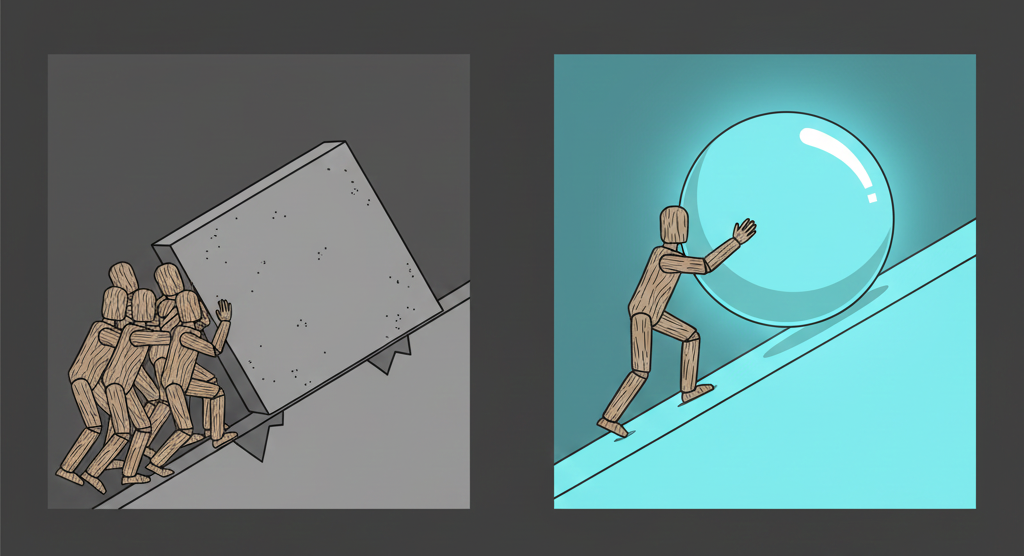
In the early stages of a company, “being busy” is the most dangerous drug. We mistake motion for progress.
I realized I was operating under a flawed equation: Maximum Effort + High Commitment = Success. But in reality, without a centralized management system, energy dissipates. My team was falling into two specific traps:
- The “Hero” Trap: We relied on individual heroism rather than scalable processes.
- The Consensus Trap: We waited for everyone to agree before moving, which is a recipe for inaction in a high-growth environment.
By allowing this culture of overload, I wasn’t leading my team to the summit. I was inadvertently encouraging “Sandbagging”—a defensive behavior where teams intentionally set lower goals just to feel safe, ensure 100% achievement, and avoid the risk of failure. This kills ambition and innovation.
The Shift: From "Hard Work" to "Smart Systems"
Creating meaningful change required me to move beyond relying solely on effort. I had to transition from being a “reactor” to becoming a strategic “thinker” who intentionally sets direction. To reinforce this shift, I established a clear, disciplined set of operating rules—systems that guide decisions, reduce noise, and ensure consistency across the board. Here is the framework I used to restore sanity.
1. Enforce the "Kill Rule" (Strategic Focus)
Startups die from indigestion, not starvation. We had too many open loops.
I learned that for a monitoring framework to work, we had to drastically limit our focus. In our first phase, we restricted ourselves to just 1 to 3 company-level goals per quarter.
The New Rule: If a project does not directly contribute to our top 3 strategic goals, it must be killed or moved to a waiting list. When we try to prioritize everything, we end up prioritizing nothing. This limitation forces us to focus our limited resources where they actually matter.
2. The "No Name, No Game" Rule (The DRI)
We used to have “shared responsibilities.” That is a myth. When two people are responsible for a goal, the result is the “Diffusion of Responsibility”.
I adopted the concept of the DRI (Directly Responsible Individual). This isn’t just about assigning a task; it’s about assigning accountability.
- The Problem: “I thought the marketing team was handling that.”
- The Solution: Every Key Result (KR) must have one specific owner. Even if a whole team works on it, one person is the DRI who has the authority to make decisions and drive it forward.
This clarity eliminates the social friction of “chasing people down” because everyone knows exactly who is holding the ball.
⚠️ Manager’s Note: Beware of the “Scapegoat” Trap; Implementing DRI can feel scary for the team. To make it work, you must support them:
- Don’t Isolate Them: Pair each DRI with a support team or advisors. Break large scopes into smaller pieces so they don’t burn out.
- Protect Psychological Safety: Avoid a “blame culture.” Promote “justified responsibility”—treat mistakes as learning data, not grounds for punishment. * Feedback Loops: Run regular feedback sessions so leaders can frame challenges as learning opportunities, not failures.
3. Replace "Consensus" with "Commitment."
One of the biggest time-wasters in my team was the endless debate trying to get everyone to agree.
We shifted to a culture of “Disagree and Commit”. We put the best ideas on the table and debated them seriously. But once a decision was made by the DRI, the debate ended. Everyone—even those who disagreed—was required to fully support the execution.
This stopped the paralysis. We prioritized decision quality and velocity over consensus.
4. Meetings are for "Blockers," Not "Updates."
I audited my calendar and realized my meetings were just people reading reports to me. That is a waste of expensive time.
We shifted to “Management by Exception”.
- Old Way: “Tell me what you did yesterday.”
- New Way: “Is your status Red or Green? If it’s Green, I don’t need to see you. If it’s Red, how can I help?”
We now use a simple 3-Question Update at the end of the week:
- Lag Measure: What is the current progress?
- Lead Measure: What is the one vital action for next week?
- Blocker: What is stopping you, and who do you need help from?
This reduced our meeting times by half and shifted the focus from “interrogation” to “coaching” and removing obstacles.
You don’t need to overhaul your entire company overnight. Start with this simple exercise to test the waters:
The “Kill Rule” Audit
- List it out: Look at the tasks you and your team completed last week.
- The 80/20 Filter: Identify the 20% of work that actually moved the needle on your top 1-3 strategic goals.
- The Challenge: For the next 7 days, apply the “Minimum Execution” principle. On every single task, ask yourself: “Does this have a clear DRI?” and “Is this directly linked to a top-level goal?”
- The Action: If the answer is no, kill the task or put it in the backlog.
Micro-Experiment (Try this in the next 7 days)
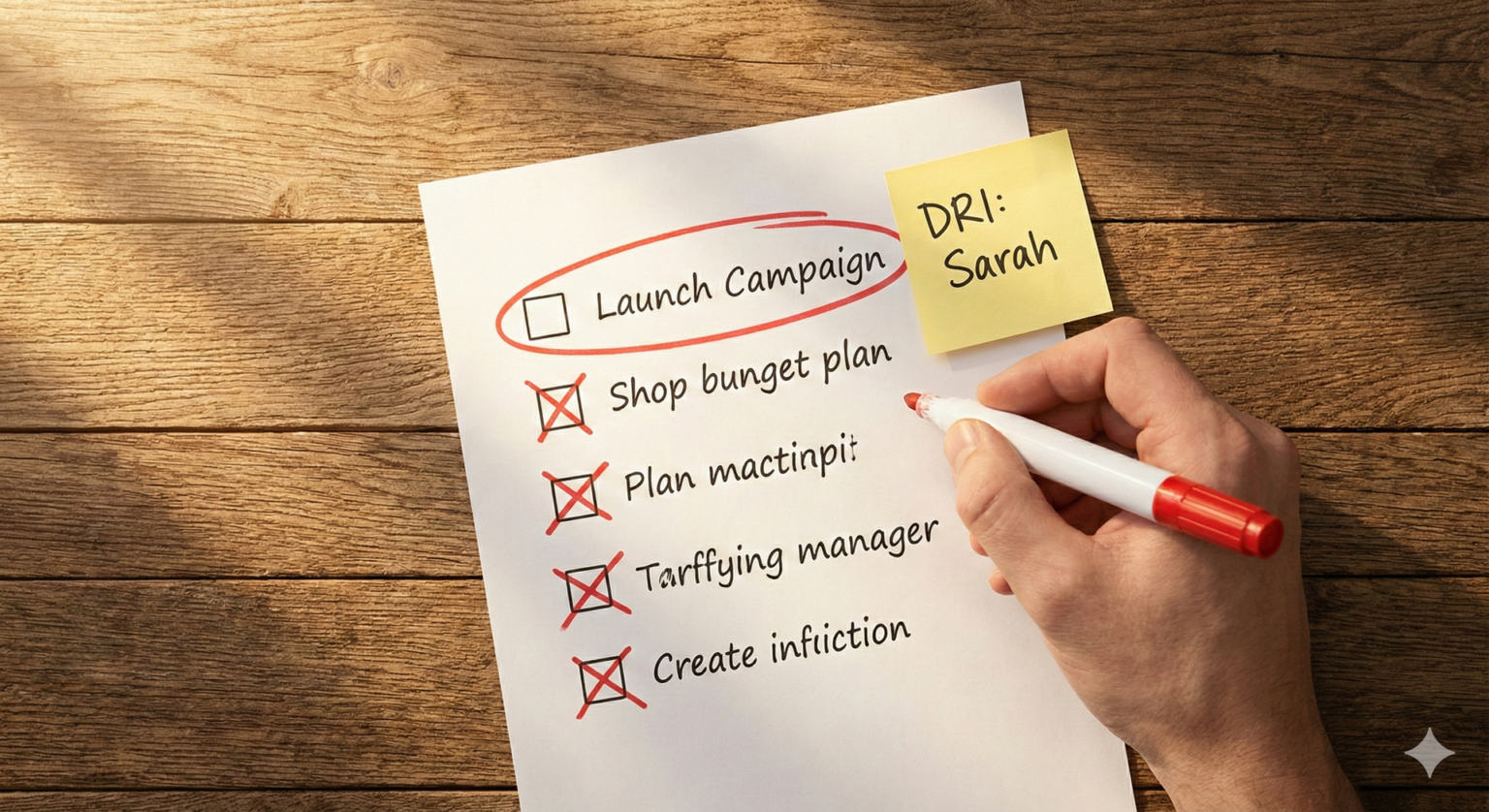
You don’t need to overhaul your entire company overnight. Start with this simple exercise to test the waters:
The “Kill Rule” Audit
- List it out: Look at the tasks you and your team completed last week.
- The 80/20 Filter: Identify the 20% of work that actually moved the needle on your top 1-3 strategic goals.
- The Challenge: For the next 7 days, apply the “Minimum Execution” principle. On every single task, ask yourself: “Does this have a clear DRI?” and “Is this directly linked to a top-level goal?”
- The Action: If the answer is no, kill the task or put it in the backlog.
Closing Thoughts
Working hard without a system isn’t heroism; it’s self-sabotage. It leads to a team that is tired, cynical, and stuck.
By shifting from “output” to “outcome” and clarifying ownership with DRIs, we didn’t just ship faster—we started sleeping again. We moved from a culture of “busy” to a culture of “impact.”
Does your team have high commitment but slow growth? Do you feel the “Overload” trap?
Share your experience in the comments below. I’d love to hear how you handle the “busy” trap.